

This Is What a Bible Looks Like When You Finally Understand What You’re Reading

Every color. Every margin note. Every arrow and underline. This is what Scripture looks like when you finally have the context to understand what you’re reading.
When I first saw a Bible that looked like this — every page covered in color, margins filled with handwritten notes, arrows connecting verses, whole passages circled and underlined — I thought the person who owned it must be some kind of scholar.
A seminary graduate. A lifelong theologian. Someone who had spent decades in deep academic study.
I was wrong.
The woman who showed me that Bible had been a Christian for eleven years. She was a school teacher. She had never taken a theology class in her life.
What she had was something most believers never receive.
Context.
I have been teaching Scripture for 18 years. I have watched hundreds of sincere, faithful believers sit in Bible study every week, open their Bibles, and quietly pretend to understand what they are reading.
Not because they are dishonest. Because they are embarrassed. Because everyone around them seems to get it. Because they have been reading the same verses for years and nodding along, hoping the understanding will eventually come.
It never comes. Not without the foundation.
And I realized one Wednesday night that I had been failing every single one of them.
The Wednesday Night I Realized I Had Been Failing My Entire Congregation

We were studying Philippians. I asked my group what Paul meant when he said “work out your salvation with fear and trembling.”
They all nodded. They all said yes, they understood.
So I pressed. “What does that mean, exactly?”
Silence.
Good answers followed. Sincere answers. But none of them knew that Paul wrote Philippians from a Roman prison. None of them knew the Philippian church was being torn apart by false teachers. None of them knew that “work out your salvation” was Paul’s direct response to that specific crisis.
They had highlighted that verse. They had heard it preached for years. And they had no idea what they were actually reading.
After everyone left, I sat alone in that empty room for a long time.
My wife found me there at 11 PM still sitting in the dark.
“What’s wrong?” she asked.
“I don’t think anyone in my Bible study actually understands what they’re reading.”
“I mean they understand when I explain it. But they can’t understand it on their own. The moment I’m not there, they’re guessing. They’re reading the Bible the way you’d read a novel in a foreign language — they can follow the plot, but they’re missing everything underneath.”
“So what are you going to do?”
“I don’t know yet.”
But I did know. I just didn’t want to admit how much work it would take.
Why Most Bibles Stay Clean — And What It Actually Means When They Do
Look at the Bible in the image at the top of this page.
Every page is covered. Yellow, pink, orange, blue, green. Handwritten notes in the margins. Arrows connecting verses. Whole passages circled. Questions answered in the white space.
That is not what a scholar’s Bible looks like. That is what a Bible looks like when someone finally understands what they are reading.
Most Bibles stay clean. A few highlights here and there. Maybe a verse underlined. But the margins stay empty because the reader does not know what to write. They are reading words they recognize but cannot fully grasp. They are moving through Scripture the way you move through a foreign city without a map — you can see everything, but you do not know what you are looking at.
The Bible is not one book. It is 66 books written by more than 40 different authors over more than a thousand years. Each one was written at a specific time, to specific people, for a specific reason.
When you read Philippians without knowing Paul wrote it from a Roman prison while the church was being torn apart by false teachers, you miss the urgency and love behind every single word.
When you read Revelation without knowing the historical context of persecution that John’s readers were living through, the imagery stays terrifying instead of becoming the hope it was meant to be.
Context changes everything. And most believers have simply never been given that context in a form they can actually use on their own.
That is the only reason most Bibles stay clean.
What I Did Next — And the Three Months That Changed Everything
The next morning I opened my computer and started writing.
Genesis.
Everything someone needs to know before reading Genesis. Who wrote it. When. Why. What was happening in the ancient world at the time. The main themes. How it fits into the larger story.
Not a sermon. Not a devotional. Just the context.
I broke it down over and over until my teenage daughter could read it and understand it completely on her own.
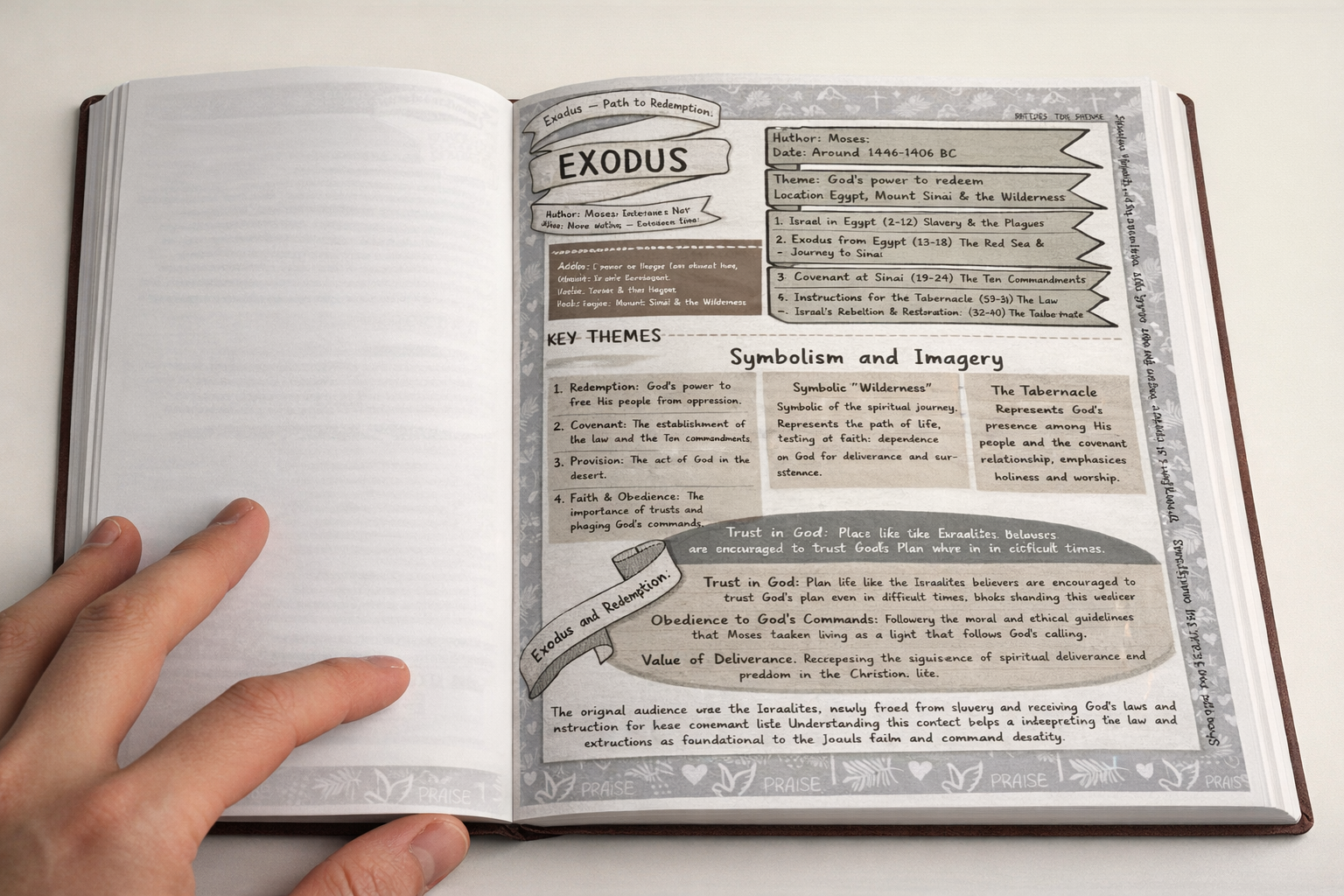
Then I did Exodus. Then Leviticus. Then Numbers.
Every single book of the Bible.
Sixty-six pages. One page per book.
It took me three months. Three months of sitting at my desk after everyone went to bed. Three months of writing and rewriting until it was as clear as I could possibly make it. Three months of taking 18 years of studying and putting it into a format that any believer could pick up and use completely on their own.
No pastor required.
What Happened the Next Wednesday Changed 18 Years of Ministry in One Night

The next Wednesday I brought those 66 pages to Bible study and put a copy at every seat.
“Before we open our Bibles tonight,” I said, “I want you to read the page on Philippians. Just read it. Then we’ll study.”
I watched them read. Then I said, “Okay. Now open your Bibles to Philippians chapter 2.”
And I watched something I had never seen before in 18 years of ministry.
Their eyes changed.
Not confusion. Not blank staring.
Understanding. Pure understanding.
One woman looked up at me, practically with tears in her eyes.
“I finally get it. I’ve been reading Philippians for years and… and… I never understood what was happening. But now… now it makes sense.”
Another man said: “Why didn’t anyone ever tell me Paul wrote this from prison while the Philippian church was dealing with false teachers? That changes everything he’s saying.”
The rest of that study was unlike anything I had experienced before. They were not waiting for me to explain it. They were discovering it themselves. Connecting things across different books. Asking questions I had never heard them ask before.
They were actually understanding Scripture.
At the end of the night one of the older men came up to me. He had been in my Bible study for six years and a Christian for forty.
“Pastor,” he said quietly, “I have been a Christian for 40 years. And this is the first time I have ever studied the Bible and felt like I actually understood what was happening. Thank you.”
I went home that night and told my wife what happened.
“They got it. For the first time, they actually got it.”
That was more than eight months ago. Since then hundreds of people have told me the same thing. “This is the first time I have ever understood what I was reading.”
Not because I am some brilliant teacher. But because I finally gave them what they actually needed.
Context.
Introducing the Saints Label Bible Study Guide

That is exactly what this guide was created to do.
It is 66 pages. One dedicated page for every book of the Bible. Each page is carefully laid out to give you exactly what you need to approach Scripture with clarity and confidence.
Who wrote the book. When it was written. Why it was written. What was happening in the world at the time. The key themes God intended to deliver. And at the bottom of every page, practical steps to apply what you are reading to your real life today.
Not vague spiritual advice. Real, actionable steps.
Did you know that the 23rd Psalm — the one read at every funeral and memorized by millions — was written by David while he was being hunted by his own son, sleeping in caves, fearing for his life? That “the valley of the shadow of death” was not a metaphor to him. It was his actual situation.
Did you know that Revelation, the book most Christians find terrifying and confusing, was written by John while he was exiled on a prison island, writing in coded language to Christians who were being actively persecuted and killed? That the symbolism was not meant to confuse. It was meant to protect.
Written in plain language. No seminary terms. No complicated theology. Just the context that makes everything you have already read suddenly make complete sense.
Because here is what I know after 18 years of teaching Scripture. The Bible is not confusing because it is unclear. It is confusing because we are reading it without the foundation that made it clear to the people it was first written for.
This guide gives it back to you.
Here Is What Believers Are Saying After Using This Guide


How Much Does It Cost to Finally Understand God’s Word?
I have watched faithful believers spend hundreds trying to find the understanding they were looking for. Seminary courses starting at $500 per class. Commentary sets costing $200 to $600. Bible study programs running $300 to $400. And after all of that, many of them still came back to me with the same questions and the same quiet frustration.
The Saints Label Bible Study Guide is regularly priced at $60. For a resource covering all 66 books of the Bible that you will return to for the rest of your life, that is already extraordinary value.
But right now during our Easter Sale:
And if you want to share it with a spouse, a family member, or your entire Bible study group, bundle discounts go even deeper.
GET YOURS NOW — Easter Sale: 35% OFFHow Do I Get My Copy Before the Sale Ends?
If you have ever sat in church nodding along while feeling completely lost inside…
If you have ever opened your Bible, read a chapter, and closed it with no idea what you just read…
If you have ever felt like you are the only one who does not understand while everyone else seems to get it…
You are not alone. And it has nothing to do with you.
You just needed context.
This guide is 18 years of studying condensed into sixty-six pages that any believer can understand and use on their own. It is my life’s work. And I am sharing it because I refuse to watch another person sit in a Bible study pretending they understand when they do not.
Get closer to God by actually understanding His Word. Not just reading it. Understanding it.
Don’t let another year go by feeling lost in Scripture.
GET YOURS NOW — Easter Sale: 35% OFF