

Peter Wasn’t Being Foolish. He Knew Exactly What He Was Looking At -- and That Changes the Entire Meaning of the Transfiguration.

This simple 66-page guide has helped thousands of believers finally understand God’s Word with clarity, confidence, and renewed faith -- even in life’s darkest moments.
When Jesus took Peter, James, and John up the mountain, something happened that none of them were prepared for.
His face shone like the sun. His clothes became dazzling white, blazing beyond anything a launderer on earth could produce. And then, standing beside Him, were two men who had been dead for centuries.
Moses. And Elijah.
The disciples fell on their faces in terror. And then Peter, because Peter could never stay quiet for long, lifted his head and said something that Christians have been laughing at for two thousand years.
"Lord, it is good for us to be here. If you wish, I will put up three shelters -- one for you, one for Moses and one for Elijah."
Most Christians read that and cringe. They think Peter was babbling out of fear. They think he was offering to build camping tents for glorified beings. They use him as a sermon illustration about speaking before you think.
But Peter was not being foolish.
He knew exactly what he was looking at. And what he was trying to do changes the entire meaning of the scene.
What Peter Actually Saw
The Greek word Peter used was not the word for a camping tent or a temporary shelter. The word he used was skenas. Tabernacles. Booths.
He was invoking the Feast of Tabernacles -- Sukkot -- the great Jewish festival that commemorated the forty years God’s presence dwelt among His people in the wilderness. During this feast, every Jewish family built a temporary booth and lived in it for seven days, re-enacting the time when God came down to live with them.
But there was a deeper layer to this feast that every first-century Jew knew by heart.
The prophet Zechariah had written that in the end times, when the Messiah finally came to establish His eternal kingdom, all nations would come to Jerusalem to celebrate the Feast of Tabernacles. It was the prophesied celebration of the Messianic age. The final feast. The beginning of the eternal reign of God on earth.
When Peter looked up and saw Jesus blazing in divine glory, standing with Moses -- who represented the entire Law -- and Elijah -- who represented all the Prophets -- he did not see a strange and terrifying vision.
He saw the fulfillment of every prophecy he had ever learned.
He thought the Kingdom had come. He thought the suffering was over. He thought the eternal celebration had begun, and he wanted to build the tabernacles because he believed the Messianic age was starting right there on that mountain.
He didn’t realize that before the crown, there had to be a cross.
And God the Father, speaking from the cloud, cut him off mid-sentence. Not to rebuke him for being foolish. But to redirect him. "This is my Son, whom I love. Listen to him."
The glory was real. The Kingdom was real. But the timing was not yet. And Peter, in his desperate eagerness to hold onto that moment, had to be gently reminded that the path to the eternal feast still ran through Calvary.
The Night My Bible Study Changed Forever
I have been a pastor for twenty years. I have preached the Transfiguration more times than I can count.
For most of those years, I used Peter as a punchline. I told my congregation: "Look at Peter, always speaking before he thinks, trying to build tents for ghosts." I got a laugh every time. I thought I was being relatable.
I was giving them a Sunday School summary of a story that carries the weight of the entire Old Testament.
The night I finally taught the connection to the Feast of Tabernacles -- the night I explained that Peter wasn’t being stupid, he was just early -- the atmosphere in the room shifted in a way I had never experienced before.
I watched people’s faces change. Not the polite nodding of people trying to follow along. Real understanding. The kind that changes how you read everything that comes after.
One woman in the back row had tears streaming down her face. She had been a Christian her entire life. She had read the Transfiguration account dozens of times. She had heard it preached from pulpits across three different churches.
She had never once been told what skenas meant.
She had never been told that Peter was looking at the fulfillment of Zechariah’s prophecy. She had never understood that the three figures standing together on that mountain -- the Law, the Prophets, and the Christ -- were the entire story of redemption compressed into a single blinding moment.
A man who had been in my congregation for forty years came up to me afterward. He stood there for a moment without saying anything. Then he said, "Pastor. I always thought Peter was just an idiot. I never knew he was looking at the fulfillment of prophecy. I never knew the tabernacles meant anything. I feel like I have been reading a book in a language I didn’t know I was missing."
That is what happens when you read the Bible without the historical and cultural context. You turn profound theological moments into confusing, disconnected stories. You miss the majesty. You miss the weight. You miss the reason the disciples fell on their faces in terror and the reason God the Father spoke from the cloud.

What You Have Been Missing
Did you know that Moses and Elijah were not chosen randomly? Moses represented the Law -- the Torah, the covenant, the commandments given at Sinai. Elijah represented the Prophets -- every voice that had pointed forward to the coming Messiah for a thousand years. Together, they represented the entirety of the Hebrew Scriptures. And Jesus stood between them, not as a continuation of the story, but as its fulfillment.
Did you know that the cloud that overshadowed them was not just a dramatic weather event? It was the Shekinah -- the visible presence of God that had filled the tabernacle in the wilderness and the temple in Jerusalem. The disciples recognized it immediately. That is why they fell on their faces. They knew what it meant when the cloud came down.
Did you know that the command "Listen to him" was a direct reference to Deuteronomy 18, where Moses had promised that God would one day raise up a prophet like himself, and the people were to listen to him? God was not just affirming Jesus. He was identifying Him as the fulfillment of Moses’ own prophecy, spoken fourteen hundred years earlier.
Context changes everything. Every single time.
The Transfiguration is not a strange, mystical interlude in the middle of the Gospels. It is the moment where the entire Old Testament and the entire New Testament converge on a single mountaintop. It is the moment where God pulls back the curtain and shows three terrified fishermen exactly who they have been following.
And Peter, far from being foolish, was the only one who understood enough to respond at all.
Introducing the Saints Label Bible Study Guide

That is exactly what this guide was created to do.
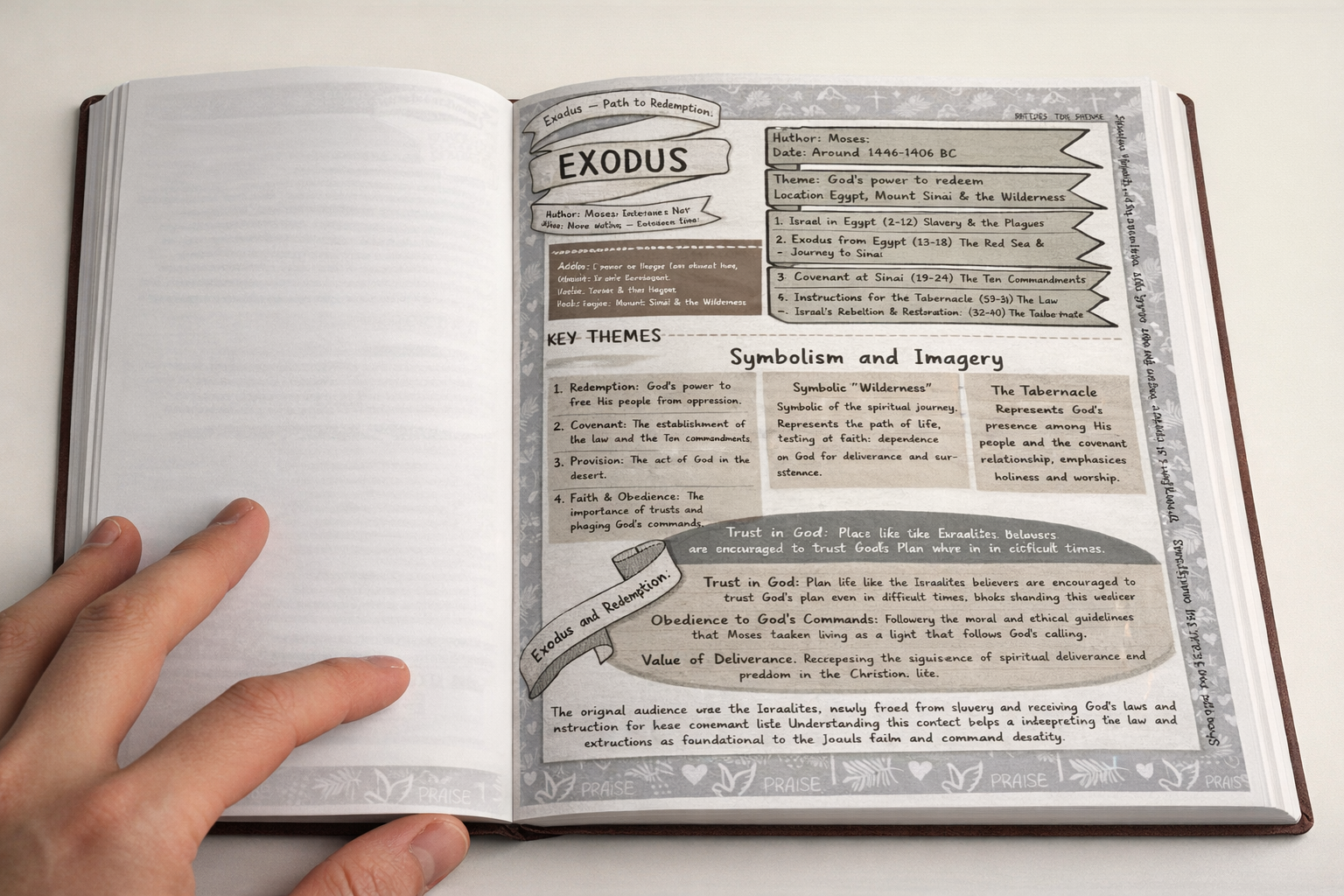
It is 66 pages. One dedicated page for every book of the Bible. Each page is carefully laid out to give you exactly what you need to approach Scripture with clarity and confidence.
Who wrote the book. When it was written. Why it was written. What was happening in the world at the time. The key themes God intended to deliver. And at the bottom of every page, practical steps to apply what you are reading to your real life today.
Not vague spiritual advice. Real, actionable steps.
Matthew. Written to a Jewish audience to prove that Jesus was the fulfillment of every messianic prophecy in the Hebrew Scriptures.
Zechariah. The prophet who described the Feast of Tabernacles in the Messianic age -- the very feast Peter was invoking on that mountain.
Deuteronomy. Moses’ final sermon to Israel, including the prophecy that God would raise up another prophet like him. The prophecy God the Father quoted on the mountain.
Revelation. The end of everything. The final feast. The eternal tabernacle. The fulfillment of what Peter glimpsed for one blinding moment on that mountaintop.
Every book laid out the same way. Clean, simple, consistent. Once you have used it for one book you instantly know how to approach the next. Your brain begins to recognize the rhythm and that familiarity builds real confidence.
Written in plain language. No seminary terms. No complicated theology. Just the context you need so that when you open your Bible you are not guessing. You are understanding.
Here Is What Believers Are Saying After Using This Guide


How Much Does It Cost to Finally Understand God’s Word?
I have watched faithful believers spend hundreds trying to find the understanding they were looking for. Seminary courses starting at $500 per class. Commentary sets costing $200 to $600. Bible study programs running $300 to $400. And after all of that, many of them still came back with the same questions and the same quiet frustration.
The Saints Label Bible Study Guide is regularly priced at $60. For a resource covering all 66 books of the Bible that you will return to for the rest of your life, that is already extraordinary value.
But right now during our Easter Sale:
And if you want to share it with a spouse, a family member, or your entire Bible study group, bundle discounts go even deeper.
GET YOURS NOW -- Easter Sale: 35% OFFHow Do I Get My Copy Before the Sale Ends?
If you have ever read the Transfiguration and wondered why Peter said what he said…
If you have ever sat in a Bible study nodding along while feeling completely lost inside…
If you have ever opened your Bible, read a chapter, and closed it with no idea what you just read…
If you have ever felt like you are the only one who does not understand while everyone else seems to get it…
You are not alone. And it has nothing to do with you.
You just needed context.
Peter saw the glory of God on that mountain and he responded with the only framework he had. He was not wrong about what he saw. He was only wrong about the timing. The Kingdom was coming. The eternal feast was coming. The tabernacle of God with man was coming.
It just had to go through the cross first.
Get closer to God by actually understanding His Word. Not just reading it. Understanding it.
Don’t let another year go by feeling lost in Scripture.
GET YOURS NOW -- Easter Sale: 35% OFF