

Most Christians Take Communion Every Week. Almost None of Them Know What They Are Actually Doing.

This simple 66-page guide has helped thousands of believers finally understand God’s Word with clarity, confidence, and renewed faith — even in life’s darkest moments.
There is a moment that happens in churches all over the world every single Sunday.
The pastor holds up a piece of bread. He holds up a cup. He says the same words that have been said for two thousand years.
This is my body, broken for you. This is my blood of the new covenant.
People bow their heads. They take the elements. They sit back down.
And most of them have no idea what they just participated in.
Not because they do not care. Not because their faith is weak. But because nobody ever told them what was actually happening at that table.
The Last Supper was not just a meal. It was a Passover Seder.
And for every single person sitting at that table with Jesus that night, the Passover was not a church tradition. It was the most sacred meal of their entire year. A ritual their people had been performing for 1,500 years. Every element of it carried meaning that every Jewish person at that table had known since childhood.
What Was Actually on That Table
The Passover Seder was not a simple dinner. It was a carefully structured ceremony with specific foods, specific prayers, and specific cups of wine -- each one tied to a promise God had made to Israel in the book of Exodus.
There were four cups of wine. Not one. Four. Each cup had a name. The Cup of Sanctification. The Cup of Deliverance. The Cup of Redemption. The Cup of Praise. Each one represented one of the four promises God made to Moses: I will bring you out. I will deliver you. I will redeem you. I will take you as my people.
Every person at that table had been drinking those four cups every Passover since they were old enough to sit at the table. They knew what each cup meant. They knew what they were saying when they drank it.
There was also the matzah -- the unleavened bread. Not because they were in a hurry. Because it was the bread their ancestors had eaten as slaves in Egypt. The bread of affliction. The bread of people who had nothing. The bread that said: we were slaves, and God set us free.
There was a lamb. There were bitter herbs to represent the bitterness of slavery. There was a mixture of apples and nuts and wine called charoset, shaped to look like the mortar their ancestors had used to build Pharaoh's cities.
Every element of the Seder was a memory. A physical, tangible reminder of what God had done for Israel 1,500 years before.
And Then Jesus Changed Everything
They had done this every year of their lives. They knew every word. Every symbol. Every cup and what it meant.
And then Jesus picked up the bread.
He took the matzah -- the bread that for 1,500 years had meant slavery and suffering and the mercy of God -- and He looked at His disciples and said: this is my body broken for you.
He was not creating a new ritual. He was stepping inside a 1,500-year-old ceremony and declaring Himself to be its fulfillment.
Think about what that meant to the people in that room. These were Jewish men who had grown up hearing the Passover story every year of their lives. They knew what the matzah meant. They knew what the lamb meant. They knew what the bitter herbs meant. And now the man they had followed for three years was picking up the bread of affliction -- the bread that meant slavery and suffering -- and saying that it was His body. That He was going to take on the suffering. That He was going to become the affliction so they would not have to carry it.
Then He took the cup. The third cup. The Cup of Redemption. The cup that for 1,500 years had meant: God redeemed us from slavery. He looked at His disciples and said: this is my blood of the new covenant, poured out for many for the forgiveness of sins.
He was not inventing a new symbol. He was completing one that had been pointing to Him for fifteen centuries.
The disciples did not fully understand it that night. They would not understand it until after the resurrection, when Jesus walked two of them through the Scriptures on the road to Emmaus and opened their minds to see how everything -- every Passover, every lamb, every cup of wine -- had been pointing to Him. But they understood enough to know that something had just shifted. The world was different now. The ceremony they had performed every year of their lives had just been fulfilled.
The Night My Bible Study Group Understood This for the First Time
I have been teaching Scripture for eighteen years. I thought I knew the Last Supper well. I had preached on it. I had written about it. I had taken Communion hundreds of times.
And then one Wednesday night I walked my Bible study group through the Passover Seder. I explained the four cups. I explained the matzah. I explained what every element meant to the people sitting at that table with Jesus.
The room went completely quiet.
One woman -- she had been taking Communion every Sunday for forty-three years -- looked up at me and said quietly: I have never understood what I was doing. I have been going through the motions my entire life.
A man in the back said: You are telling me that when Jesus said this is my body, He was holding the bread of affliction -- the bread that meant slavery -- and saying that He was going to take that slavery onto Himself?
Yes. That is exactly what He was saying.
Another woman said: And the cup He held up was the Cup of Redemption? The cup that had meant God redeemed us from Egypt for 1,500 years?
Yes. That is the cup He chose. Out of four cups on the table, He chose that one.
The room was silent for a long time. And then one of the older men in the group said something I have never forgotten.
I have been a Christian for fifty years. And tonight is the first time I have ever understood what I believe.

What You Have Been Missing
Did you know that Jesus did not drink the fourth cup at the Last Supper? The Cup of Praise -- the final cup of the Seder, the cup that completed the ceremony -- He set it down and said: I will not drink of this fruit of the vine from now on until that day when I drink it new with you in my Father's kingdom. The Seder was left unfinished. On purpose. The next time Jesus drank wine was on the cross, when a soldier offered Him sour wine on a hyssop branch. The same branch used to apply the Passover lamb's blood to the doorposts in Egypt. He finished the Seder on the cross.
Did you know that the middle piece of matzah at the Passover Seder -- called the Afikomen -- was broken, wrapped in linen, hidden, and then brought back at the end of the meal? Jewish families had been doing this for centuries without fully understanding why. The middle piece of three. Broken. Wrapped in linen. Hidden. Brought back. The parallels to the burial and resurrection of Jesus are not accidental. They are a 1,500-year-old picture of what was coming.
Did you know that the words Jesus used -- this is my blood of the new covenant -- were a direct reference to Jeremiah 31? God had promised through Jeremiah that a day would come when He would make a new covenant with Israel. Not like the covenant He made at Sinai. A covenant written on their hearts. Jesus, at that table, was announcing that the day Jeremiah had prophesied was now. The new covenant was beginning. And it was beginning with Him.
Did you know that the Passover lamb had to be examined for four days before it was slaughtered? From the 10th to the 14th of Nisan, the lamb was kept in the home, examined for any defect, confirmed to be without blemish. Jesus entered Jerusalem on the 10th of Nisan -- the day the lambs were brought into the city. For four days, the religious leaders questioned Him, tested Him, tried to find a defect. They could not. On the 14th of Nisan, the Passover lambs were slaughtered. That was the day Jesus was crucified. The timing was not coincidence. It was the point.
This is what the Bible is. Not a collection of inspiring stories. Not a moral guidebook. A single, unified narrative that spans 1,500 years of history, in which every element points forward to the same moment -- a man at a table, holding up a cup of wine, saying: this is my blood. The ceremony ends here. The story it was telling has arrived.
Introducing the Saints Label Bible Study Guide

That is exactly what this guide was created to do.
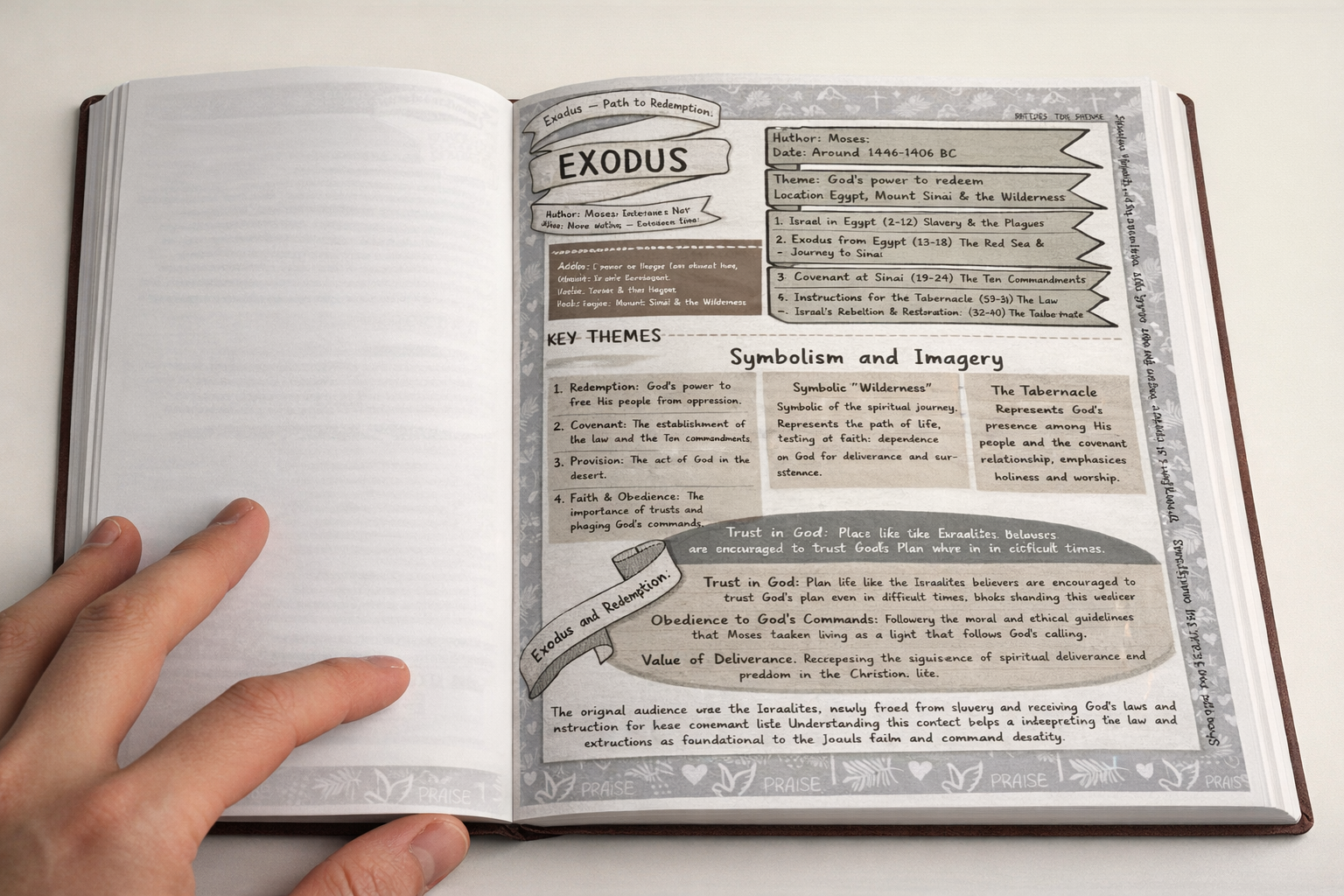
It is 66 pages. One dedicated page for every book of the Bible. Each page is carefully laid out to give you exactly what you need to approach Scripture with clarity and confidence.
Who wrote the book. When it was written. Why it was written. What was happening in the world at the time. The key themes God intended to deliver. And at the bottom of every page, practical steps to apply what you are reading to your real life today.
Not vague spiritual advice. Real, actionable steps.
Romans. Paul’s letter to a divided church laying out the foundation of salvation by faith.
John. Written so that you may believe that Jesus is the Christ, the Son of God.
James. What it actually means to follow Him. Not just say you do.
Revelation. The end of everything. The final judgment. The eternity waiting on the other side of this life.
Every book laid out the same way. Clean, simple, consistent. Once you have used it for one book you instantly know how to approach the next. Your brain begins to recognize the rhythm and that familiarity builds real confidence.
Written in plain language. No seminary terms. No complicated theology. Just the context you need so that when you open your Bible you are not guessing. You are understanding.
Because here is what I know after six years of watching people face death. The questions they ask in those final moments are not complicated. They are simple. Is there something after this? Does any of it mean anything? Was God there?
This guide gives you the foundation to find those answers yourself. Not from a nurse. Not from a pastor. From the Word itself.
Here Is What Believers Are Saying After Using This Guide


How Much Does It Cost to Finally Understand God’s Word?
I have watched faithful believers spend hundreds trying to find the understanding they were looking for. Seminary courses starting at $500 per class. Commentary sets costing $200 to $600. Bible study programs running $300 to $400. And after all of that, many of them still came back with the same questions and the same quiet frustration.
The Saints Label Bible Study Guide is regularly priced at $60. For a resource covering all 66 books of the Bible that you will return to for the rest of your life, that is already extraordinary value.
But right now during our Easter Sale:
And if you want to share it with a spouse, a family member, or your entire Bible study group, bundle discounts go even deeper.
GET YOURS NOW — Easter Sale: 35% OFFHow Do I Get My Copy Before the Sale Ends?
If you have ever sat in church nodding along while feeling completely lost inside…
If you have ever opened your Bible, read a chapter, and closed it with no idea what you just read…
If you have ever felt like you are the only one who does not understand while everyone else seems to get it…
If you have ever stared at the ceiling at 3am wondering if any of it is real, if any of it means anything, if God is actually there in the dark with you…
You are not alone. And it has nothing to do with you.
You just needed context.
This guide changed my life during the darkest season I have ever known. Six years of watching people die left me empty. Two weeks with this guide gave me back something I didn’t know I had lost.
Get closer to God by actually understanding His Word. Not just reading it. Understanding it.
Don’t let another year go by feeling lost in Scripture.
GET YOURS NOW — Easter Sale: 35% OFF