
The 82-Year-Old Woman In Our Theology Group Sees What Seminary Graduates Miss. Her Secret Has Nothing To Do With How Much She Has Read.

I want to tell you about Eleanor.
She is 82 years old. Taught elementary school her whole career. Never went to Bible college. Never took a theology class. Never read a systematic theology textbook.
But every single week in our Wednesday night theology group, she is the one who sees what the rest of us miss.
Our group has twelve people. Three have seminary degrees. Two are pastors. One taught Bible at a Christian college for 15 years.
And then there is Eleanor.
Last month we were working through Hebrews. One of the seminary graduates said he had never fully understood why Hebrews spends so much time on Melchizedek. It felt like a tangent.
Eleanor shook her head.
It is not a tangent. It is the whole point. The author is showing that Jesus is not just another Levitical priest. He is a priest in the order of Melchizedek. Which means his priesthood predates the Mosaic law and supersedes it.
The room was silent.
One of the pastors said: I studied Hebrews in seminary and nobody explained it that clearly.
Eleanor smiled. Once you know the context of each book and how they fit together, the connections just show up.
What Eleanor Sees That The Rest Of Us Miss
This happens every week.
Someone brings up a passage. The group debates meaning. We reference commentaries.
And Eleanor will say something like: The reason Paul quotes Habakkuk 2:4 in Romans 1 is because Habakkuk is dealing with the same question. How does God's justice work when the righteous suffer? Paul is showing that the gospel answers what Habakkuk was asking 600 years earlier.
Or: When Jesus says I am the bread of life in John 6, he is standing in the same region where God gave manna in the wilderness, talking to people whose ancestors ate that manna, claiming to be what the manna was pointing to all along.
She does not just know what passages say. She knows how they connect.
The seminary graduates started asking her: How do you know all this?
Her answer: I do not know more than you. I just have something that shows me where each piece fits.
The Night A Seminary Graduate Asked Her To Explain Hebrews
I asked her about it after group one night.
Eleanor, what is that thing? Because I have read the Bible multiple times and I am not seeing the connections you are seeing.
She pulled out a worn binder.
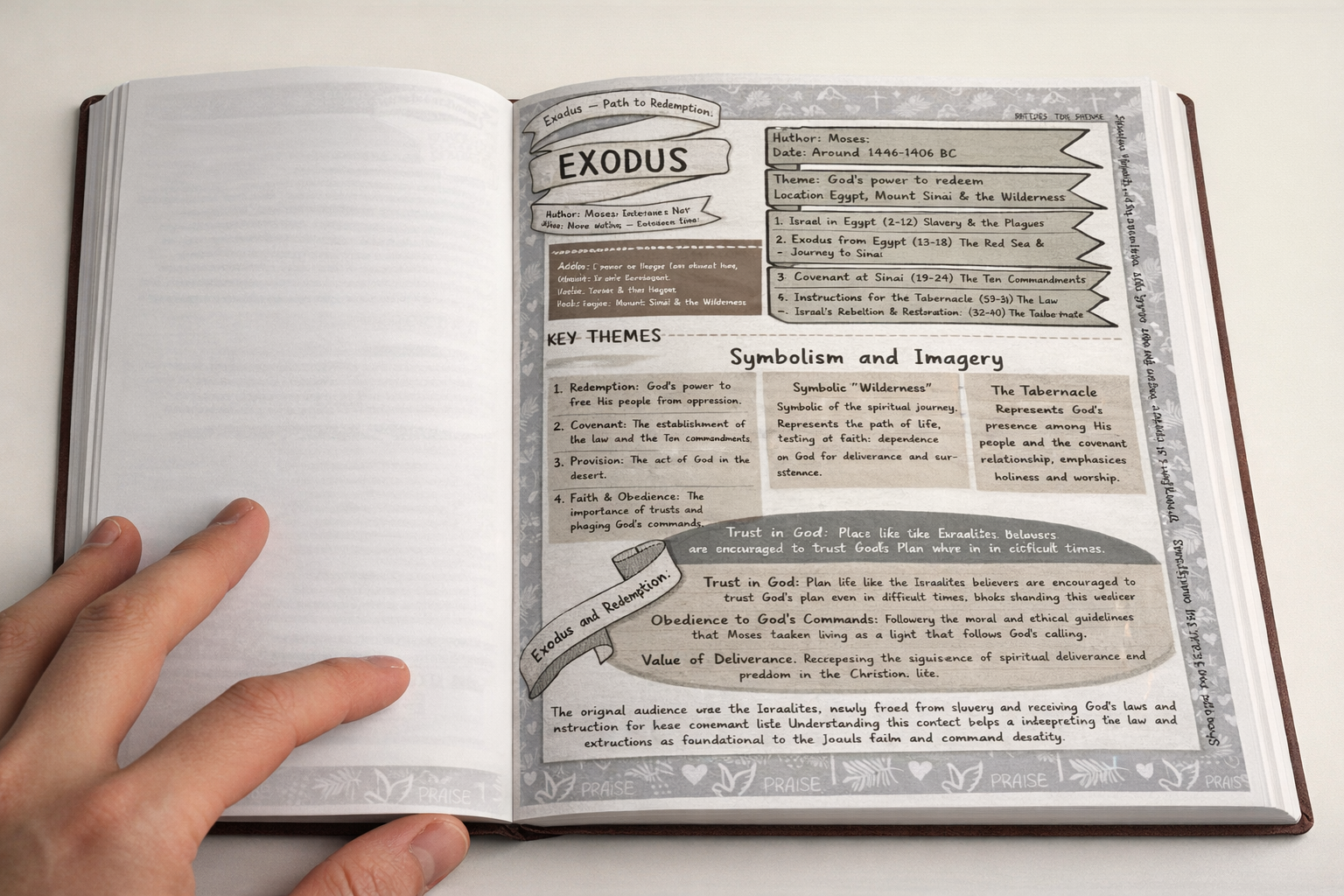
Every book of the Bible has a page. Who wrote it. When. Why. What was happening historically. I read that page before I read the book. Every time.
But you do more than that, right? You are seeing typology, themes, connections across testaments.
She shook her head. No. The connections show up once you know the context. You do not have to hunt for them.
She opened to the page for Exodus.
When you know Exodus was written around 1445 BC, to show how God redeemed his people from slavery and established covenant with them. Then when you read the Gospels and see Jesus called the Lamb of God, you immediately think: Passover lamb. Exodus. The blood that saved Israel from death.
It is not that I am smarter. It is that I know what each author was doing in their time, so when another author references them later, I see the thread.
What She Showed Me After Group One Night
She made me a copy of her binder. Same 66 pages. One per book.
Week 1, I read through Genesis with the context page. Who wrote it. When. Why. Then I read Genesis.
And for the first time, I saw it as a setup.
God promises Abraham a nation, a land, blessing to all nations through his offspring. The rest of Genesis shows that offspring line narrowing. Abraham. Isaac. Jacob. Judah.
By the end of Genesis, the family is in Egypt. Not in the Promised Land. The promises are not fulfilled yet.
Then I read Exodus with its context. And I realized: Exodus is the next chapter. God is fulfilling the promise to make them a nation.
I was not reading disconnected books anymore. I was reading one story unfolding across multiple books.
Week One. Genesis. And For The First Time I Saw It As A Setup.
By Week 12, I had read through the entire Bible. Not for the first time. But for the first time seeing how it fits together.
The Law establishes covenant. The Prophets call Israel back to covenant and promise restoration. The Gospels announce the restoration arrived in Jesus. The Epistles explain what that means for the church. Revelation shows where it is all heading.
It is not 66 disconnected books. It is one unified story told across 1,500 years by 40 authors who are all pointing to the same thing.
I had been reading the Bible for 20 years. I had never seen that before.
Not because I was not reading. Because I was reading without context. And without context, you get pieces. With context, you get the masterwork.
The next Wednesday I brought this up in theology group. Eleanor nodded.
Most people teach you how to interpret verses. Nobody teaches you how to see the big picture first. But if you do not have the big picture, biblical literacy is impossible.
Introducing the Saints Label Bible Study Guide

Eleanor is 82 years old. She has never been to seminary. But she sees how Scripture fits together better than people with theology degrees.
Not because she is smarter. Because she reads context before content. Every time. For every book. The guide she uses is the Saints Label Bible Study Guide. 66 pages. One for every book of the Bible. The key themes God was communicating. And practical steps to bring what you read into your actual life today.
Each page gives you what you need before you read. Who wrote it. When. Why. What was happening in the world at the time. Written in plain language. No seminary terms.
Just the context that makes everything you have already read suddenly land with the full weight God intended.
Because here is what I know after 18 years of teaching Scripture.
The Bible is not confusing because it is unclear. It is confusing because we are reading it without the world it came from.
That father running makes sense when you understand what running cost him. The robe and the ring and the sandals make sense when you understand what each one declared. The older son standing outside makes sense when you understand who Jesus was looking at when He stopped talking.
This guide gives you that world back.