

John Said He Wasn’t Worthy to Untie His Sandal. Here’s What That Actually Meant.

This simple 66-page guide has helped thousands of believers finally understand God’s Word with clarity, confidence, and renewed faith — even in life’s darkest moments.
John the Baptist was not a timid man.
He wore camel hair and ate locusts and honey. He stood in the Jordan River and called the Pharisees a brood of vipers to their faces. He told Herod Antipas, the ruler of Galilee, that his marriage was unlawful. He said it publicly. He said it repeatedly. He said it until Herod had him arrested and eventually executed.
John was not afraid of anyone.
Except Jesus.
When Jesus came to the Jordan to be baptized, John tried to stop Him. "I need to be baptized by you," he said, "and do you come to me?"
And before that, when the religious leaders sent priests and Levites to ask John who he was, John said something that most Christians have read without understanding the full weight of what he was saying.
"I am not worthy to untie the strap of his sandal."
Most Christians read that as humility. A figure of speech. John being modest.
Here is what most Christians have never been told.
In the ancient Jewish world, untying a master's sandal was the task of the lowest household slave. Not a servant. A slave. And even that was considered too degrading for a student to do for his rabbi. The Talmud records the teaching explicitly: a student may do for his teacher everything a servant does for his master, except untie his sandals. That was beneath the dignity of a student.
John was not saying he was less important than Jesus. He was saying that the most degrading task in the entire social hierarchy of his world was still too honorable a position for him to occupy in relation to Jesus.
The man who called Pharisees vipers to their faces. The man who confronted a king. The man who drew crowds from all of Jerusalem and Judea and the Jordan region to hear him preach.
That man said he was not worthy to perform the task that was beneath the dignity of a student.
The Symbol Nobody Explained to You
The Spirit of God descended like a dove. And a voice from heaven said: "This is my beloved Son, with whom I am well pleased."
Most Christians picture a peaceful, beautiful moment. Sunlight on water. A white dove. A gentle voice.
Here is what changes everything.
The dove.
In the ancient world, the dove carried one specific meaning that every Jewish person standing on that riverbank would have recognized immediately.
Genesis 8. After the flood. Noah sent out a dove from the ark to see if the waters had receded from the face of the ground. The dove returned with an olive leaf. The flood was over. The judgment had ended. A new world was beginning.
The dove was the symbol of a new creation emerging from the waters of judgment.
And now here was the Spirit of God descending as a dove over the waters of the Jordan. Over a man coming up out of the water.
God was not just affirming His Son. He was announcing that a new creation had begun. That the world was being made new. That what Noah's flood had pointed to, what every Passover had pointed to, what every sacrifice in the temple had pointed to, was now standing in the Jordan River dripping wet.
The old world was ending. A new one was beginning. And it was beginning with this man.
The Night Everything Changed
That is the problem I discovered three years ago sitting in a room with my Bible study group.
I have been teaching Scripture for 18 years. And one Wednesday night I asked my group why the Spirit descended as a dove specifically.

Silence.
They looked at each other, looked at their Bibles, looked at their notes.
One person said it was a symbol of peace.
Nobody knew it was the symbol of new creation from Noah's flood. Nobody had connected the dove over the Jordan to the dove over the waters in Genesis. Nobody understood that John's statement about the sandal was not modesty but a declaration of absolute unworthiness from the most fearless man in Israel.
They had read it. They had highlighted it. They had heard it preached from pulpits for years. And they had no idea what they were actually reading.
That night after everyone left I sat alone in that empty room for a long time, thinking about the dove. Thinking about how many times those people had read that story without understanding that God was announcing a new creation.
The next morning I opened my computer and started writing.
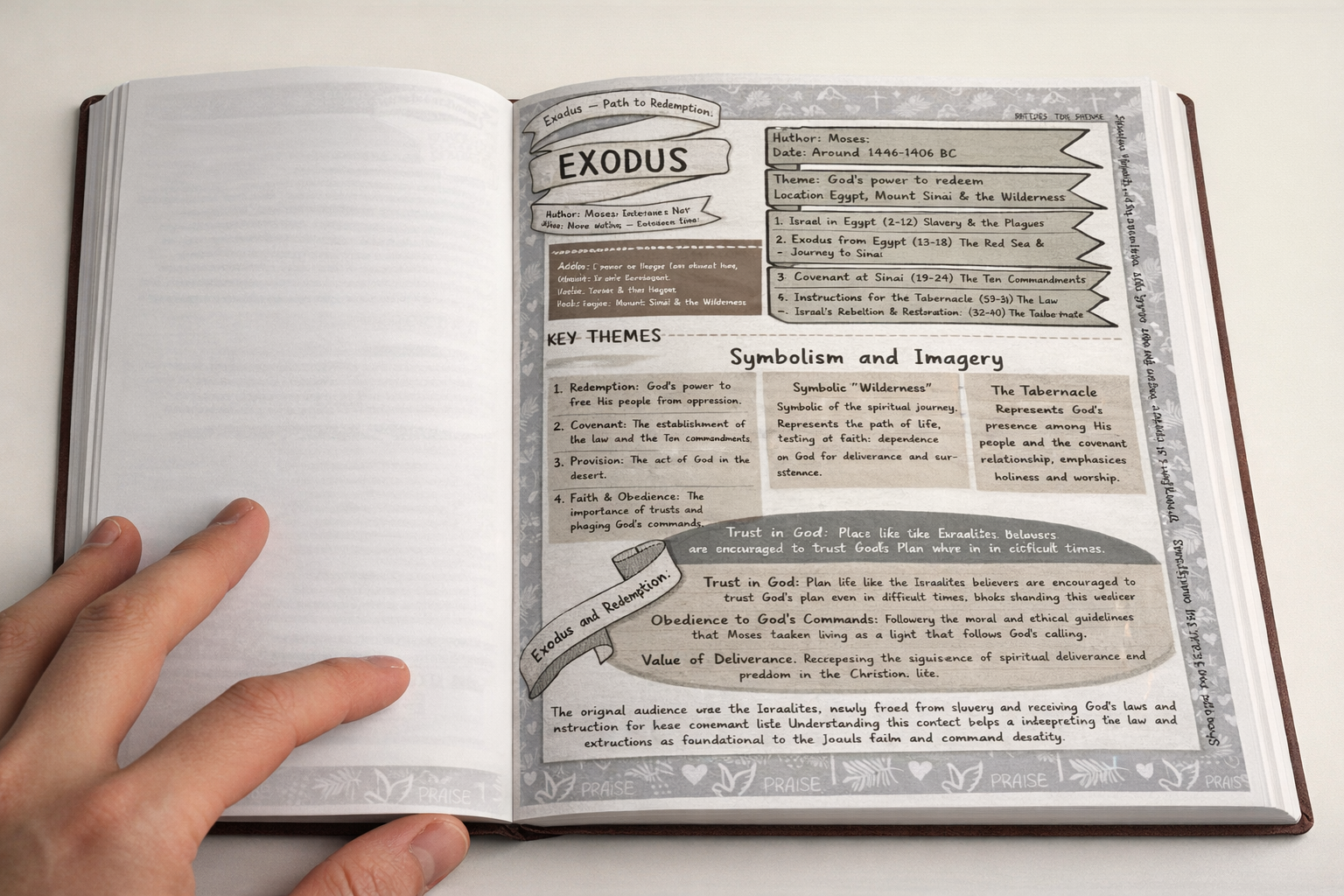
Genesis. Everything someone needs to know before reading Genesis. Who wrote it. When. Why. What was happening in the ancient world at the time. The main themes. How it fits into the larger story.
Not a sermon. Not a devotional. Just the context.
I broke it down over and over until my teenage daughter could read it and understand it completely on her own. Then I did Exodus. Then Leviticus. Then Numbers. Every single book of the Bible. Sixty-six pages. One page per book. It took me three months.
What Happened When They Finally Understood
The next Wednesday I brought those 66 pages to Bible study and put a copy at every seat.
"Before we open our Bibles tonight," I said, "I want you to read the page on Matthew. Just read it. Then we will study."
I watched them read. Then I said, "Okay. Now open your Bibles to Matthew chapter 3."
And I watched something I had never seen before in 18 years of ministry. Their eyes changed. Not confusion. Not blank staring. Understanding. Pure understanding.
One woman looked up at me practically with tears in her eyes. "I have read this story my entire life. And tonight is the first time I understood the dove. God was announcing a new creation. The same symbol from Noah. The flood was over. Something new was beginning."
A man across the table said quietly, "John said he wasn't worthy to untie his sandal. Not as a figure of speech. That was the lowest task in their entire society. And John said even that was too honorable for him. I have read that a hundred times and I thought it was just humility."
Another woman said, "The heavens opened. The Spirit descended. The Father spoke. All three. At the same moment. Over one man standing in a river. I have never felt the weight of that until right now."
At the end of the night one of the older men came up to me. He had been in my Bible study for six years and a Christian for forty. "Pastor," he said quietly, "I have been reading my Bible my whole life. And I feel like I have only just now actually started to understand it. Thank you."
What You Have Been Missing
Did you know that Jesus was baptized in the Jordan River, the exact same river Israel crossed into the Promised Land under Joshua? The Jordan was not just a geographical location but a theological one. The place where God's people had entered the land of promise. And now the one who would bring them into the ultimate promised land was stepping into those same waters.
Did you know that immediately after His baptism, Jesus was led by the Spirit into the wilderness for forty days? The same number of years Israel wandered in the wilderness. The same number of days Moses was on the mountain. The same number of days Elijah traveled to Horeb. God does nothing without meaning.
Did you know that the voice from heaven at the baptism quoted two passages simultaneously? "This is my beloved Son" is from Psalm 2, the coronation psalm of the Davidic king. "With whom I am well pleased" is from Isaiah 42, the first Servant Song. God was announcing in one sentence that Jesus was both the King and the Suffering Servant. The entire mission, declared over the waters of the Jordan before He had preached a single sermon.
Context changes everything. Every single time.
I call it the Bible Study Guide. It has 66 pages. One for every book of the Bible. Each page gives you what you need before you read. Who wrote it. When. Why. What was happening in the world at the time. The key themes God was communicating. And practical steps to bring what you read into your actual life today.
Written in plain language. No seminary terms. No complicated theology. Just the context that makes everything you have already read suddenly land with the full weight God intended.
Sixty-six books. One page each. Everything you need to finally understand what you have been reading your whole life.
Click below to get yours.
Introducing the Saints Label Bible Study Guide

That is exactly what this guide was created to do.
It is 66 pages. One dedicated page for every book of the Bible. Each page is carefully laid out to give you exactly what you need to approach Scripture with clarity and confidence.
Who wrote the book. When it was written. Why it was written. What was happening in the world at the time. The key themes God intended to deliver. And at the bottom of every page, practical steps to apply what you are reading to your real life today.
Not vague spiritual advice. Real, actionable steps.
Romans. Paul’s letter to a divided church laying out the foundation of salvation by faith.
John. Written so that you may believe that Jesus is the Christ, the Son of God.
James. What it actually means to follow Him. Not just say you do.
Revelation. The end of everything. The final judgment. The eternity waiting on the other side of this life.
Every book laid out the same way. Clean, simple, consistent. Once you have used it for one book you instantly know how to approach the next. Your brain begins to recognize the rhythm and that familiarity builds real confidence.
Written in plain language. No seminary terms. No complicated theology. Just the context you need so that when you open your Bible you are not guessing. You are understanding.
Because here is what I know after six years of watching people face death. The questions they ask in those final moments are not complicated. They are simple. Is there something after this? Does any of it mean anything? Was God there?
This guide gives you the foundation to find those answers yourself. Not from a nurse. Not from a pastor. From the Word itself.
Here Is What Believers Are Saying After Using This Guide


How Much Does It Cost to Finally Understand God’s Word?
I have watched faithful believers spend hundreds trying to find the understanding they were looking for. Seminary courses starting at $500 per class. Commentary sets costing $200 to $600. Bible study programs running $300 to $400. And after all of that, many of them still came back with the same questions and the same quiet frustration.
The Saints Label Bible Study Guide is regularly priced at $60. For a resource covering all 66 books of the Bible that you will return to for the rest of your life, that is already extraordinary value.
But right now during our Easter Sale:
And if you want to share it with a spouse, a family member, or your entire Bible study group, bundle discounts go even deeper.
GET YOURS NOW — Easter Sale: 35% OFFHow Do I Get My Copy Before the Sale Ends?
If you have ever sat in church nodding along while feeling completely lost inside…
If you have ever opened your Bible, read a chapter, and closed it with no idea what you just read…
If you have ever felt like you are the only one who does not understand while everyone else seems to get it…
If you have ever stared at the ceiling at 3am wondering if any of it is real, if any of it means anything, if God is actually there in the dark with you…
You are not alone. And it has nothing to do with you.
You just needed context.
This guide changed my life during the darkest season I have ever known. Six years of watching people die left me empty. Two weeks with this guide gave me back something I didn’t know I had lost.
Get closer to God by actually understanding His Word. Not just reading it. Understanding it.
Don’t let another year go by feeling lost in Scripture.
GET YOURS NOW — Easter Sale: 35% OFF